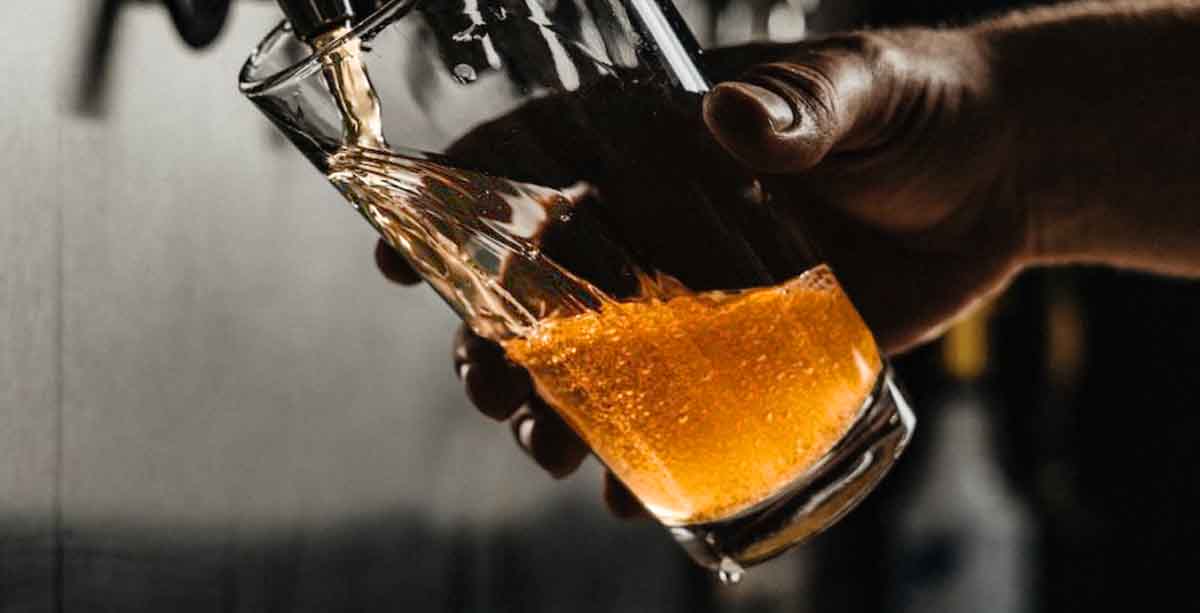
New groundbreaking research has investigated the burning questions of why beer tastes better cold and shed light on some myths regarding the dreaded hangover.
In most parts of the world many people would gladly tell you there are few more refreshing things than a cold beer, particularly on a hot day.
A study by scientists at the Chinese Academy of Sciences has published results on its work into the relationship between alcohol content and temperature, and taste perception.
The majority of alcohol in beverages is ethanol, which its found exhibits behaviour dependent on temperature, affecting what is known as the ‘contact angle’ of molecules.
Solutions of varying concentrations of ethanol mixed with water were tested and it was found temperature played a crucial role in shaping molecular structures.
Lower alcohol concentrations of ethanol tend to adopt ‘pyramid-shaped’ structures around water molecules. As the concentration increased the ethanol molecules begin to align themselves more like a chain, linked end-to-end.
But crucially, as solutions were chilled from room temperature to 5°C (41°F) there was a distinct increase in the formation of the chain-like structures.
Concentrations from 5-11 per cent – the typical range for regular and many craft beers – exhibited a notable increase in chain-like structures.
Lighter and low-carb beers, typically with around 3-5 per cent alcohol, had an increase but not as significant.
The researchers suggest their findings demonstrate 5°C is in fact the ideal temperature for beer consumption and enjoyment.
“When the temperature drops, the structure becomes more compact, which is why chilled beer has a more stimulating taste,” said the study.
The findings could help the beverages industry optimise taste profiles with lower alcohol concentrations, which have seen an increase in demand.
And while the conclusions are helpful for proprietors serving beer to optimise the patron experience, the news is hardly new. More than a decade ago American giant Coors Brewing released a colour-changing can that indicated it had reached optimal drinking temperature.
A summary by the CAS also shed light on urban folklore of the order of alcohol consumption.
“Liquor after beer, never fear … beer after liquor, never sicker” – it is said, or vice-versa, depending on personal preference.
The researchers found that, contrary to popular belief, the order of consumption does not mitigate the intensity of a hangover, finding the primary factor is the volume and pace of alcohol consumption.