Melbourne’s CBD is becoming increasingly driven by hospitality, with pubs, cafés and restaurants taking a larger share of consumer spending despite an overall decline in physical retail and hospitality activity.
New analysis from data and technology company Experian found that physical retail and hospitality spending in Melbourne’s CBD was 14 per cent lower in FY26 than in FY23.
However, the composition of that spending has changed significantly, with hospitality gaining ground as traditional retail categories declined.
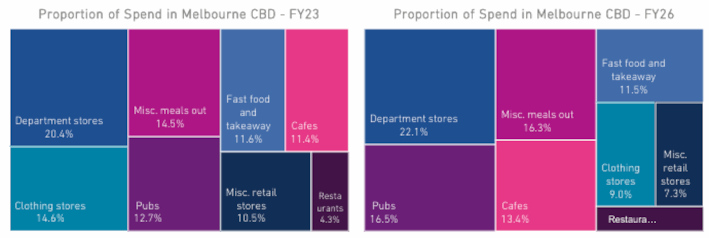
Pubs increased their share of CBD retail and hospitality spending from 12.7 per cent in FY23 to 16.5 per cent in FY26, while cafés and restaurants also recorded a larger share.
By comparison, clothing fell from 14 per cent to 9 per cent of spending over the same period, while miscellaneous retail declined from 10.5 per cent to 7.3 per cent.
The shift suggests Melbourne’s CBD is not simply losing consumers but changing how and why people spend when they visit the city.
Interstate visitors are becoming particularly important to the hospitality and broader CBD economy.
Their share of retail and hospitality spending increased from 26.6 per cent in FY23 to 30.7 per cent in FY26, with total spending from this group rising five per cent. Regional visitors also increased their share by around two percentage points, while spending from local and suburban residents declined.
Younger consumers are another significant part of the changing CBD customer base. People aged 18 to 34 accounted for 36.3 per cent of spending in the Melbourne CBD, compared with 27.6 per cent across greater Melbourne. Consumers aged 55 and over contributed 26 per cent of CBD spending, below their 31 per cent share across metropolitan Melbourne.
Experian’s head of Analytics Consulting & Insights, Louis Tsang, said the figures point to a changing CBD spending landscape, with pubs, cafés and restaurants capturing a larger share of consumer activity even as overall physical retail and hospitality spending remained below FY23 levels. Interstate visitors are also playing a growing role in supporting CBD spending.
“For retailers, hospitality operators, lenders and property stakeholders, this highlights the importance of looking beyond total spend.
“Understanding which catchments, customer groups and categories are supporting activity can help organisations assess local demand, identify emerging opportunities and make more informed decisions.”
For hospitality operators, however, stronger spending does not necessarily mean an easier operating environment.
Across Australia, hospitality businesses generally recorded higher FY26 closure rates than retail stores. Sydney’s CBD recorded the lowest retail closure rate among the Australian CBDs analysed, but the highest closure rate for eating and drinking businesses.
Higher hospitality closure rates were also recorded in inner-urban precincts, including Richmond, South Yarra and Brunswick, and in Sydney, Surry Hills and Newtown.
The findings highlight a changing CBD hospitality market, where consumer demand is increasingly concentrated around dining, drinking and social experiences, while operators continue to contend with costs, labour pressures and changing customer behaviour.
The full report can be found in the August edition of Experian Business Pulse Monthly.