The NSW Government is joining the party in the night-time economy, furthering its Special Entertainment Precincts and releasing the inaugural State of the Night report to measure its impact for the first time.
The new report provides the full picture of how NSW communities come alive after dark, the diversity of choices and activity, and the businesses, venues and workers who make it happen. It was developed using assorted data to capture trends, highlight opportunities and track the evolving patterns of participation.
It revealed the night-time economy generates almost $110 billion annually. Over 168k businesses are employing 1.3 million workers between 6pm and 6am, which is nearly three out of every 10 in NSW.
Key insights
The night economy is far more than just Sydney’s CBD, growing 6.4 per cent across central Sydney and 4.2 per cent in western Sydney.
Since FY23 the night workforce has grown $120 million in value, with 2,400 new businesses and another 11k jobs.
Nearly one in every five dollars of daily in-person spending in the state took place at night, although the sector continues to face the ongoing challenge of being heavily exposed to shifts in discretionary spending, and since FY23 in person spending has decreased by $1 billion (6pc) while online spending increased by $3.5 billion.
Efforts to help strengthen the sector have counted ongoing investment in infrastructure and cultural projects, regulatory reform, regional expansion, and government strategies including the NSW Night Worker Action Plan, launched in 2025, proposing practical interventions such as greater access to services for night workers.
And after 12 agonising years, the Labor government recently announced the end of the last of the lockout laws restricting Sydney hotels and damaging the city’s international reputation. AHA NSW CEO John Whelan says it’s a “huge relief” to finally see them abolished.
“Credit to the Minns Government for all they’ve done over the past 3 years to bring vibrancy back to nightlife in NSW.”
The past year has brought an ease to inflation, low unemployment and an uptick in the growth of domestic private spending, which government sees as “groundwork for optimism”.
The Office of the 24-Hour Economy has been producing its quarterly Data After Dark reports, but the new format allows it to summarise progress on an annual basis.

“The NSW Government has committed to unlocking the potential of our night-time economy, and so it’s appropriate that we monitor the impact of our work,” says 24-Hour Economy Commissioner Michael Rodrigues.
Click HERE for a copy of the State of the Night report.
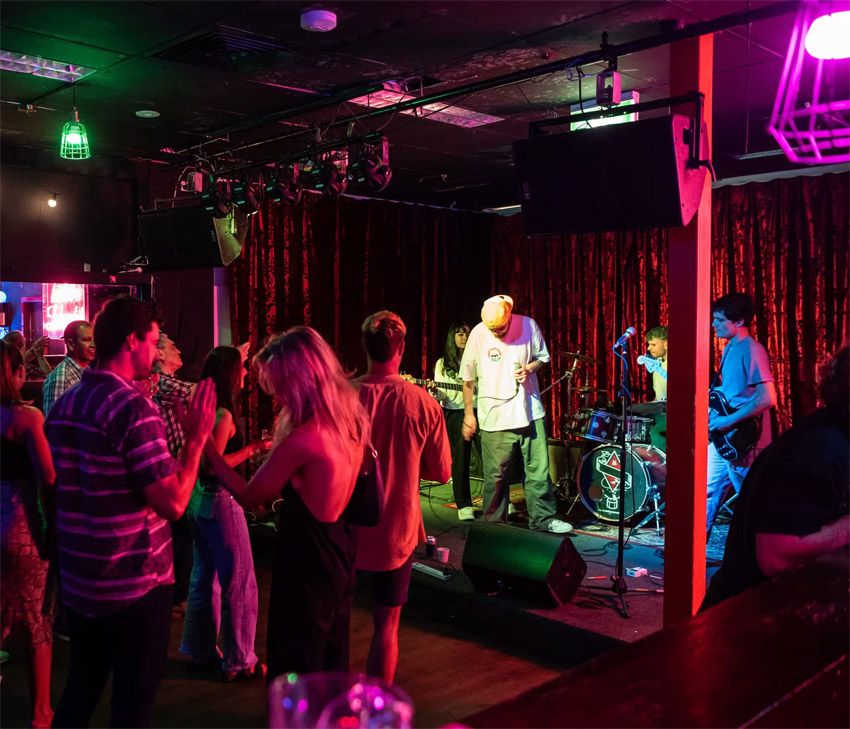
Special Entertainment Precincts (SEP) support the growth of live entertainment by fast-tracking extended trading hours for live music venues and providing favourable sound regulation.
Last year’s report into the NSW night-time economy by the Productivity and Equality Commissioner identified that special, precinct-wide rules in SEPs can cut costs, reduce delays and attract investment. They save businesses an estimated $30k and months in wait time by avoiding the usual Development Application (DA) costs on applications for extended trading hours.
SEPs let councils manage activity in defined areas, introducing precinct management plans to set trading hours and sound requirements. They can also mandate appropriate sound attenuation in new buildings and ensure new property buyers are aware they are moving into an area where entertainment is encouraged.
SEPs trials are already taking place across NSW and 22 councils have passed resolutions to investigate or establish one in their areas. Councils receiving grants under round one of the SEP Kickstart Grant program to establish trials include Burwood, Fairfield, Byron Shire, Sutherland Shire, Hornsby, Liverpool, Northern Beaches, Tamworth and Goulburn.
“Interest in the model from across the State is encouraging,” says Rodrigues.
“We know that people are looking to enjoy a night out closer to home. We look forward to working with councils and their communities to make that happen.”
The Commissioner is offering an additional $1.25 million to support more local councils looking to establish their own SEP trials, with grants ranging from $20k-200k available to eligible councils through Round 2 of the program.
Councils can also apply for up to another $50k to explore Purple Flag accreditation, which is an international framework recognising precincts that achieve high standards of excellence, and are welcoming and vibrant after dark.
“As we look ahead to the next 12 months, I think we can be optimistic about continued improvements as more businesses and communities embrace the opportunities under the Vibrancy Reforms, more Special Entertainment Precincts are established across the state, and we deliver on the commitments in the state’s 24-Hour Economy Strategy,” concludes Rodrigues.
Click HERE for more information or to apply.